

“Give me a lever long enough and a fulcrum on which to place it, and I shall move the world.”
Archimedes
Time is valuable and we have a limited supply of it. Much wisdom is based in understanding and grappling with the brevity of life. In this series of blog posts I want to give you access to a host of different systems that can save you time, and increase how rich your life is. Because it is an article and not a book it won’t be quite as deep, but where possible I will reference the relevant resources so that you can go deeper.
The first topic we will focus on is habits.
Habits and How to Form Them
Habits are one of the highest leverage activities, because consistent, little actions will change you in incredible ways over time. This is the premise of James Clear’s book Atomic Habits. He shares this in a powerful way pointing out that if you get 1% better every day for a year, you would be 37 times better by the end of one year because of the cumulative gains. Habits can cascade in powerful ways!
Beyond this if you focus on what Charles Duhigg calls keystone habits you can amplify that impact. Keystone habits are habits that have outsized leverage. These could be things that touch on core parts of who you are, like your identity, health, work or spirituality.
Examples of Keystone habits would be:
Regular Exercise: This boosts mood, and often prompts people to eat healthier, sleep better, and think more clearly. Daily exercise extends lifespan and health.
Daily Planning: this creates clarity around what you want to get done each day and allows you to intentionally tackle these things. You will find yourself much more focused.
Eating Family Dinners: Bonding your family together, laying the ground work for better communication and healthier eating.
Tracking Finances: Awareness often is the first step of change. Tracking finances gives awareness and will make you much more conscious of where you are overspending, and possibly underspending.
Making Your Bed: This one is odd, but it is something that creates a sense of accomplishment early in the day and allows you to identify deeply with success.
Your keystone habit might not be listed here, but when you find what habits you need to implement, you can see powerful and lasting change in your own life. But how can you actually make the habit happen?
BJ Fogg, a behavioral scientist and researcher from Stanford University in his book Tiny Change says that most people don’t experience lasting change unless they have an epiphany, a change in circumstances or that change starts really small. In this I want to help you start small This is an insight that inspires Atomic Habits, and it’s four rules of habit change:
Make it small
Make it easy
Make it obvious
Make it attractive
If you want to kill a bad habit invert these rules.
These thought patterns take advantage of the habit cycle that Duhigg lays out in his book the Power of Habit.
Habit
Cue
Reward
Habits form at various rates. Often the statistic 21 days is thrown around however this isn’t a reliable amount of time amount for forming a habit. Some studies list as long as 60 days. Others reduce it to much less. Duhigg points out that the the above cycle is quite important in forming habit, as much of what makes a habit is unconscious.
High Leverage Habits
It makes sense after thinking through the habit cycle to get really specific, what are the best habits to make sure that I form. Obviously, this a question that no one can answer but you. There are unique circumstances in your life, and your existing character and needs shape what’s best for you to prioritize. However that said, there are sources that have isolated a few different habits that are quite potent.
There are dozens of resources. Two that I have found the most helpful would be 7 Habits of Highly Effective People by Stephen Covey and Brendan Burchard’s High Performance Habits. Both contain similar and rewarding habits that they lay out for people hoping to grow towards maturity.
The habits layed out by both Burchard and Covey are proven habits that when done in succession will generate a ton of helpful results.
Here’s a summary of their thoughts.
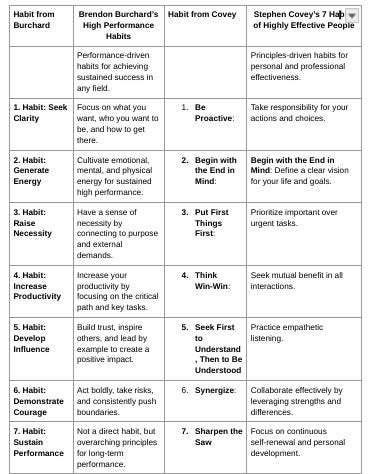
Key Differences:
Brendon Burchard emphasizes energy management and necessity, with a strong focus on increasing one's influence and productivity for high performance.
Stephen Covey emphasizes principles, focusing on long-term personal effectiveness through internal discipline and external cooperation (e.g., win-win thinking, synergy).
Both sets of habits promote personal and professional growth but take different approaches—Burchard focuses more on performance optimization, while Covey emphasizes character development and lasting personal effectiveness.
Conclusion
Time is limited. We’ve explored a path to automating some of the most important things in life. Make it your habitual approach to be intentional, to begin with the end in mind, generate energy and so many other things. It will make an incredible difference. Continue on this path and your life could get dramatically better.